Turning “the air smells bad again” into public evidence a city can't ignore.
Residents of Vadodara regularly smell chemical and burning odours, but complaints vanish into thin air. Airkind lets anyone report a smell in one tap, asks nearby neighbours to confirm it, and turns the reports into shareable proof. Next to it is an honest, measured air-quality map.
Open airkind-five.vercel.app ↗- Problem
- Residents smell chemical and burning odours, but single complaints get dismissed and air-quality apps blur real data with guesses.
- Role
- Product concept, UX and content design, UI, the full build, and data-integrity rules.
- What shipped
- An installable web app with one-tap reports, neighbour confirmations, an honest AQI map, and shareable PDF and story evidence.
- Result
- Live, with complete flows for reporting, alerts, maps and downloads, backed by 70 automated tests.
- Platform
- Installable web app (PWA)
- Engagement
- Designed & built
- Scope
- Product concept · UX & content design · UI design · Full-stack build · Data integrity
- To file a report. Smart defaults fill in the rest
- 1 tap
- Nearest neighbours asked "can you smell it too?"
- 25
- Automated tests (55 unit + 15 end-to-end)
- 70
- Made-up numbers. No data means an honest empty state
- 0
Context
What was in the way
- A single complaint is easy to dismiss. People can't see that hundreds of neighbours smell the same thing.
- Reporting tools ask for too much — forms, phone numbers, app-store installs — so people give up.
- Air-quality apps blur measured data, model estimates and opinions, so nobody trusts the numbers.
- People report while the smell is happening, often at night and half-asleep
- No app-store accounts and no phone numbers
- Sensitive topic, so trust and privacy come before features
- Real air-quality stations are few, and some data is only modelled
The bet
If reporting takes one tap and neighbours can confirm it, scattered complaints become evidence people can't ignore.
Key decisions
The calls that shaped it
Each one with the reasoning, and what was deliberately left out. The screens follow from these.
- Decision 01Accepted
Two worlds, never mixed — community reports and measured AQI
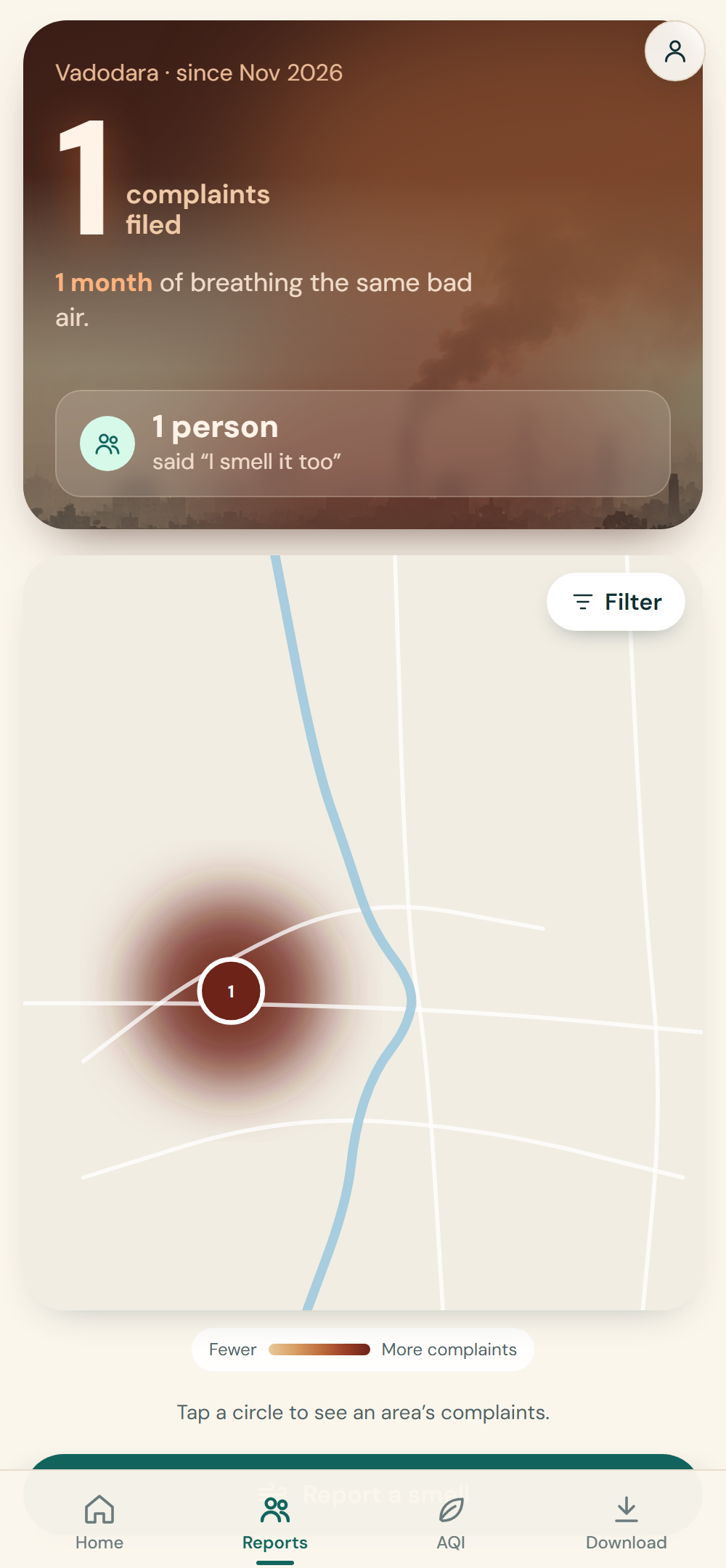
WhyA smell report is an observation, not a measurement. The two are kept apart in the UI, the API and the database, with different map styles (warm brown dots versus official AQI colours). The app's credibility depends on it.
Not doneOne combined "air score" that mixes complaints with measurements.
- Decision 02Accepted
A neighbour chain instead of a lone complaint
WhyEach report alerts the 25 nearest residents. Every "yes, I smell it too" alerts 25 more. One person's complaint becomes a confirmed, mapped incident, with caps and quiet hours so it never turns into spam.
Not doneAlerting the whole city, or sending alerts with no limits or quiet hours.
- Decision 03Accepted
A one-screen report with smart defaults
WhySmell "Not sure", strength "Strong", time "Just now", place "here". Most people only need to press Send. Each row opens inline chips when you want to change it. No pickers, no forms.
Not doneA multi-step form with dropdowns and pickers.
- Decision 04Accepted
Never fabricate a number
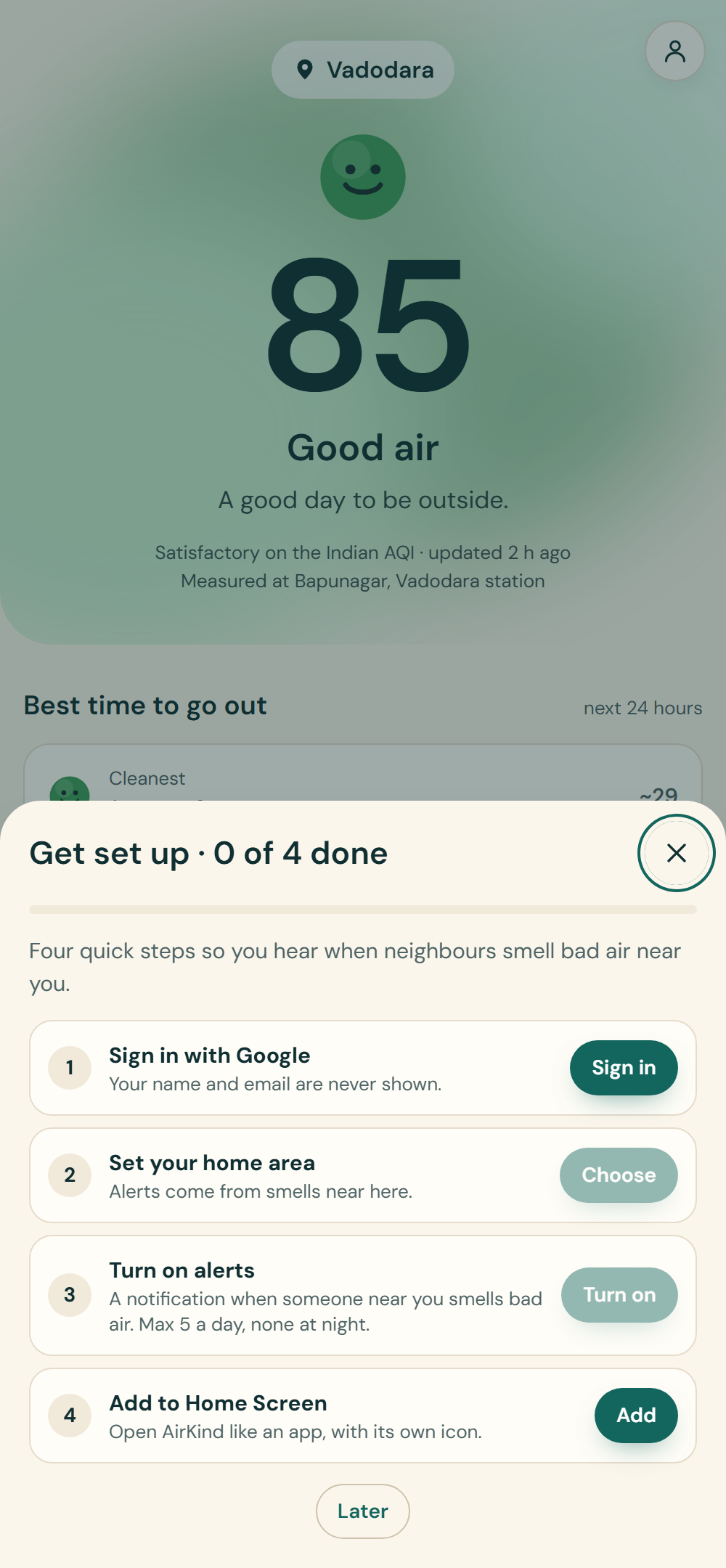
WhyIf no air-quality station is reachable, the app says so. Model estimates are labelled "Modelled" and are never ranked against real stations. Honesty is a design feature.
Not doneFilling gaps with estimates or sample numbers.
- Decision 05Accepted
Make it shareable to get it noticed
WhyA one-tap PDF report for officials and journalists, and 9:16 story images for WhatsApp Status and Instagram. Evidence that leaves the app reaches the people who can act on it.
Not doneKeeping the evidence locked inside the app.
- Decision 06Accepted
Private by design, without over-promising
WhyGoogle sign-in with no phone number. Locations are stored as roughly 1 km grid cells. The copy says exactly what's shown and what isn't, and never claims "anonymous".
Not donePhone-number sign-up, or promising anonymity the app could not guarantee.
Artifacts
From the working documents
Report · resident
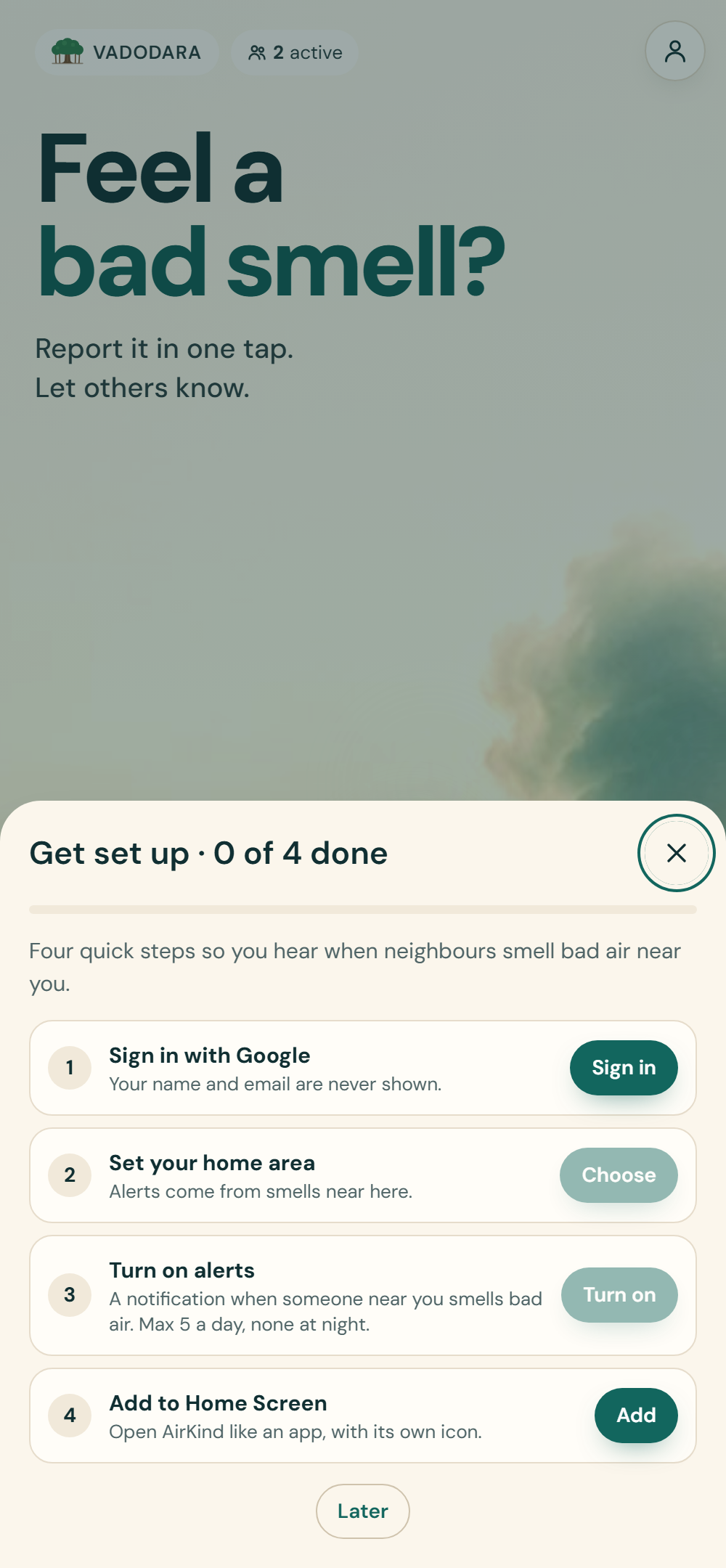
- Home asks "Feel a bad smell?"
- Smart defaults filled in
- Press Send
- 25 nearest neighbours alerted
Confirm · neighbour
- Alert "Can you smell it too?"
- Yes or No
- Each Yes alerts 25 more
- Incident mapped publicly
The story
Why this exists
Ask anyone in Vadodara about the smell at night and they’ll have a story. What they don’t have is proof. Complaints go to a helpline and disappear. Each person thinks they’re the only one.
The goal was to change the unit of evidence from “one annoyed person” to “this many neighbours, this area, this time, again”.
Designing for a 3-second attention span
People report a smell while they’re smelling it, often late at night, half-asleep, eyes stinging. So the home screen asks exactly one question and offers one huge button. Everything else is a default you can change but don’t have to.
The neighbour alert is designed the same way. “Can you smell it too?” with two big answers. Late alerts change their wording (“Did you notice it earlier?”) so the data stays honest.
The rule behind every screen: a smell report is never treated as a measurement.
Designing for trust
Civic apps live or die on credibility. Every AQI number shows its station, scale and time of reading. When there’s nothing to show, the screen says “We never fill in or guess numbers.” Reports are public, but reporters never are.
The result is a product that residents can use in one tap, and one that a journalist or official can take seriously.
The product
What it looks like
Outcome
Where it landed
- Live as an installable web app. No app-store accounts needed
- Complete flows for reporting, neighbour alerts, the reports map, the AQI map and downloads
- Push notifications, offline reports that send when back online, and a 4-step onboarding checklist
- Built to grow beyond smell. Other civic issue types can be added without changing the database
What this means for your product
Good product design for sensitive topics is mostly about what you refuse to fake. Trust is the feature.
Talk about your product →